
Every capital project reaches a moment when the board asks one question: when will it be finished? That question is usually asked at a funding milestone or stage gate, such as approval to enter FEED, final investment decision, or release of the construction budget, when the board is about to commit significant capital. The answer they are usually given is a single date from the schedule. That date is almost always the wrong one to commit to.
A deterministic schedule assumes every activity takes exactly its planned duration and that no risk ever happens. On a pharmaceutical or biotechnology capital project, that assumption does not survive contact with the project. Long-lead equipment, regulatory milestones and a commissioning and qualification phase that rarely runs to plan all add uncertainty. So does construction itself: these projects rely on numerous individual trade contract partners, from civil, structural and building services contractors to cleanroom, process pipework and specialist equipment installers. Coordinating their sequencing, interfaces and handovers is a complex and risky undertaking in its own right.
In most schedule risk analyses I run, the chance of hitting the deterministic date is well under 50%.
So the real question is not “what date does the schedule show?” It is “what level of confidence do we want in the date we announce?” That is where P50, P75 and P80 come in.
What the P-dates actually mean
A schedule risk analysis runs the project schedule thousands of times in a Monte Carlo simulation. Each run draws a duration for every activity from its agreed range and fires risk events according to their probability. The result is not one finish date but a spread of them.
The P-dates are read from that spread:
- P50 is the date the project finishes on or before in half of the simulations. It is an even bet.
- P75 is the date it beats in three runs out of four.
- P80 is the date it beats in four runs out of five.
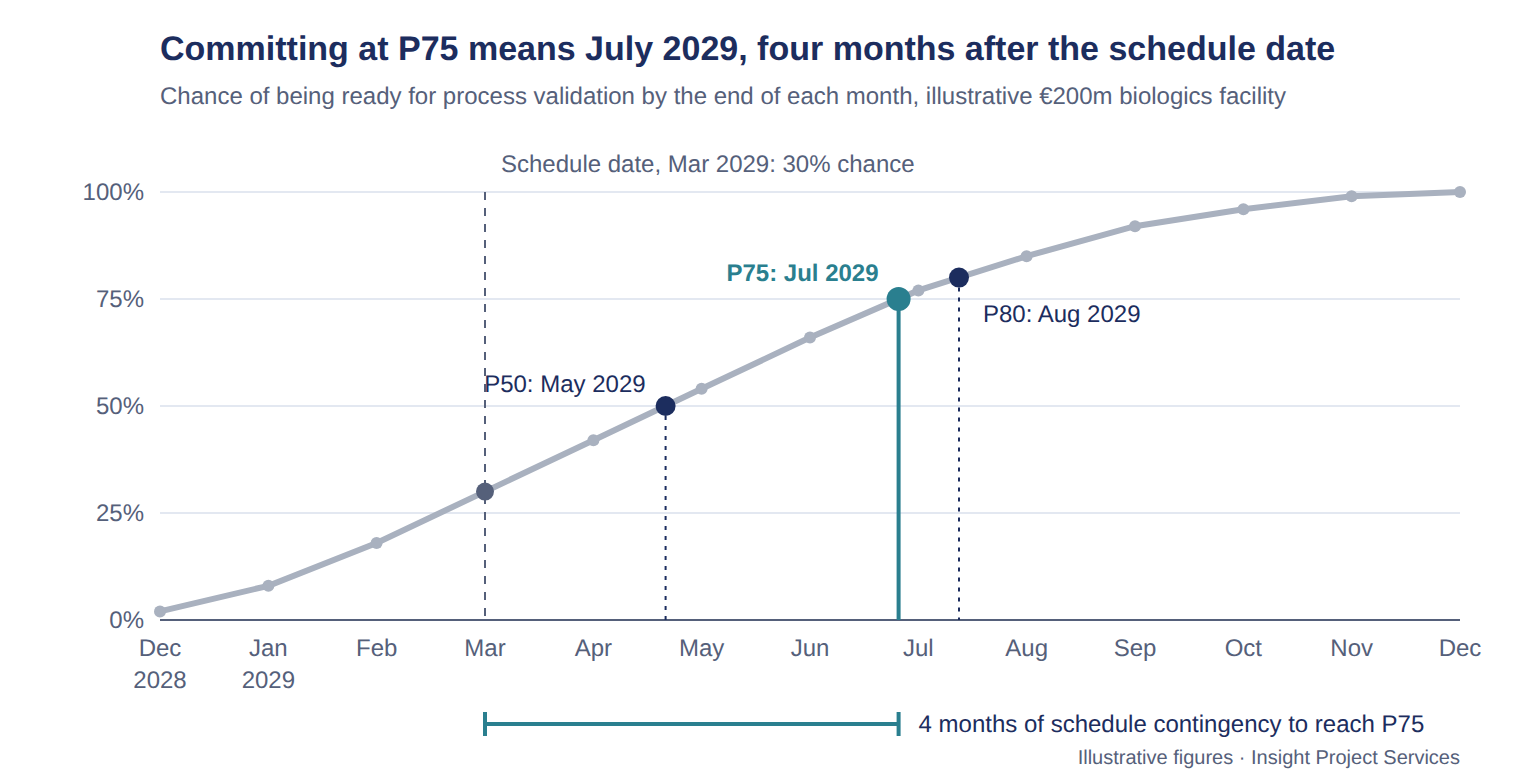
The gap between the deterministic date and any of these is the schedule contingency needed to reach that level of confidence. It is not padding. It is the measured cost of the uncertainty in the plan.
The S-curve shows how the chance of finishing rises month by month. The schedule’s own date sits low on the curve; each P-date is simply where the curve crosses that level of confidence.
Why the choice matters
Each step up in confidence costs time. Moving from P50 to P75 or P80 typically adds weeks, sometimes months, to the committed date. Boards feel that cost immediately, in the business case, the launch plan and the market’s expectations.
The cost of committing too low is less visible but usually larger. A P50 date announced as a commitment will be missed half the time. On a new manufacturing facility, a missed date can delay product supply, regulatory submissions and revenue, and it erodes trust in every date the project team gives afterwards.
The right confidence level is therefore a business decision, not a technical one. The risk analysis tells the board what each level of confidence costs. The board decides which it is willing to pay for.
P50, P75 and P80 compared
There is no single correct answer, but each level has a natural use.
| Confidence level | Chance of meeting it | Best used for |
|---|---|---|
| P50 | 1 in 2 | Internal targets the project team works to; never a public commitment |
| P75 | 3 in 4 | Board commitments on owner-funded pharma and biotech projects, where speed to market matters and the team can actively manage risk |
| P80 | 4 in 5 | Lender, investor and public commitments, and milestones with contractual penalties or regulatory consequences |
For most owner-funded life sciences projects, I recommend the board commits to the P75 date and the project team manages to the P50. The difference between them becomes the contingency the project director controls, and it is drawn down only when a specific risk occurs.
Where a lender, investor or regulator is relying on the date, P80 is the more common expectation, and it is the level many project finance due diligence reviews ask for.
A worked example
Take an illustrative €200m biologics facility, with mechanical completion followed by a 9-month commissioning and qualification phase. The deterministic schedule shows the facility ready for process validation in March 2029.
The risk analysis returns:
| Date | Ready for process validation | Contingency over deterministic |
|---|---|---|
| Deterministic | March 2029 | none |
| P50 | May 2029 | 2 months |
| P75 | July 2029 | 4 months |
| P80 | August 2029 | 5 months |
The deterministic March date has less than a one-in-three chance of being met. The board now has a real choice. It can commit to July and hold four months of contingency. It can commit to August if lenders or partners need a higher degree of certainty. Or it can fund the mitigations the analysis identifies, typically earlier long-lead procurement or additional C&Q resources, and rerun the model to bring every date forward.
What it should not do is announce March.
A P-date is only as good as the model behind it
Any of these dates can mislead if the analysis behind it is weak. Three things decide whether a board can trust them.
- A sound schedule. Before any simulation, the schedule needs a quality review: a critical path that holds together, and every activity linked to a successor. One missing successor can leave hundreds of activities showing float they don’t have, and the simulation will quietly understate the risk.
- An honest risk workshop. Duration ranges and risk events must come from the people who will deliver the work: engineering, procurement, construction and C&Q leads. Ranges set too narrow are the most common reason P-dates prove optimistic.
- Realistic links between risks. When one part of a project struggles, others usually do too. A model that treats every activity as independent lets good and bad outcomes cancel out, and produces P-dates that are earlier than reality.
Get these right and the P-dates become a reliable basis for a decision. Get them wrong and the analysis gives false confidence, which is worse than none.
Recommendations
- Never commit to the deterministic date. It is the most optimistic version of the plan, not a forecast.
- Commit to P75 on owner-funded projects. Manage the team to the P50, and hold the difference as contingency controlled by the project director.
- Use P80 where others rely on the date: lenders, investors, partners, regulators, or milestones with contractual penalties.
- Decide the confidence level before seeing the dates. Choosing it afterwards invites picking whichever date looks best.
- Rerun the analysis at each stage gate. FEED, FID, baseline and the start of C&Q are the natural points to confirm the date still holds.
The choice between P50, P75 and P80 is ultimately a statement of how much risk the business is prepared to carry. A good schedule risk analysis makes that choice explicit, evidence-based and defensible.